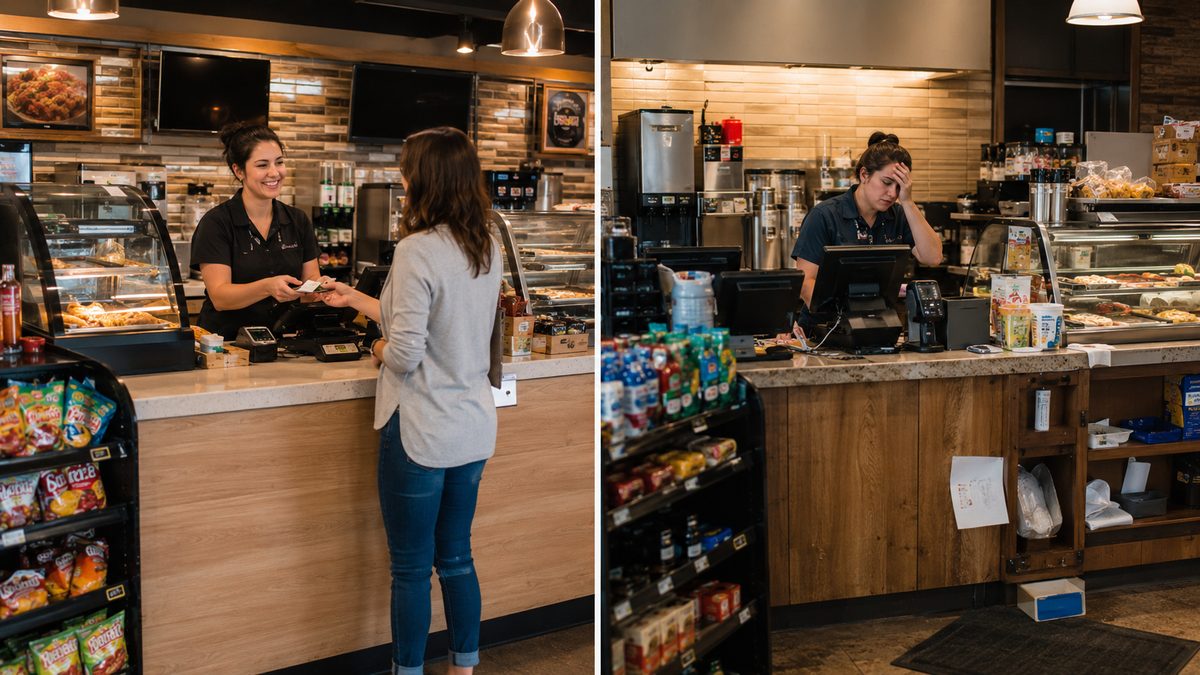
Why Your Franchise Locations Perform Differently (And What to Do About It)
You have spent years building the system. The recipes are documented down to the gram. The SOPs are clear, comprehensive, and available to every location. The equipment is standardized. The training program is the same for every new hire.
And yet: your top-performing locations consistently outperform your bottom ones by 20%, 30%, sometimes more. Customer satisfaction scores vary wildly. Food cost percentages swing by location in ways that cannot be explained by local pricing or supplier differences. You know the gap exists. You can see it in the numbers. But pinning down exactly where execution breaks down, and why, has always been just out of reach.
This is the blind spot of multi-location restaurant operations. And it is not a training problem. It is an execution measurement problem.
The Consistency Paradox
Here is what makes this problem so maddening: every input is standardized, but the output is not.
- Same brand identity
- Same menu and recipes
- Same SOPs and procedures
- Same equipment and suppliers
- Same training program
- Same technology stack
Different execution. Different customer experience. Different financial results.
The variable is human execution. How the work actually gets done, shift by shift, station by station. And until recently, that variable has been essentially unmeasurable at scale.
Why Traditional Approaches Fail
Operators have thrown everything they have at this problem. None of the traditional tools fully solve it. Here is why.
Mystery Shoppers
Mystery shopper programs sample a single visit out of hundreds. They measure the experience on one day, at one time, as perceived by one person. They cannot tell you what happens on Tuesday morning when the new hire is on the make line alone. They are expensive to scale, slow to report, and measure perception rather than process.
Digital Checklists
Completion-based systems (Zenput, Jolt, and their equivalents) give you a green checkbox. But a checked box does not equal correct execution. When the 6 AM opener checks "station sanitized," you have a compliance record. You do not know whether sanitization was performed to standard or rushed through in 30 seconds.
More Training
The default response to inconsistency is "retrain." But if the original training was adequate (and for most mature chains, it is), the problem is not that workers do not know the standard. The problem is that they drift from it over time, particularly when no one is watching. Additional training addresses awareness. It does not address execution. This distinction between content delivery and execution verification is central to understanding the three generations of restaurant training technology.
Manager Oversight
The most effective consistency tool in any chain is a strong general manager. But managers cannot watch every station on every shift. They have dozens of other responsibilities. And their presence creates a Hawthorne effect: workers perform to standard when observed and revert to shortcuts when the manager walks away. The problem compounds when, as is increasingly common, shift managers themselves were promoted without formal training in how to maintain standards.
The core issue: Every traditional approach either measures the wrong thing (checklists measure compliance, not quality), samples too infrequently (mystery shoppers), or depends on human attention that cannot scale (managers).
See How TamTov Works
AI vision that watches every station. Voice coaching that guides in real time. One standard, every location.
Apply for Early AccessWhat "Execution" Actually Means
Let us get specific. When we say "execution varies across locations," we mean observable, measurable differences like these:
- Portioning: Location A puts 4oz of protein per serving. Location B drifts to 5oz. That 25% variance costs real money multiplied across thousands of servings per week.
- Build sequence: The recipe says sauce, then protein, then cheese, then veg. Workers develop their own sequence. It does not seem to matter until a new menu item requires a specific order for structural integrity or heat distribution.
- Timing: Hold times, cook times, assembly speed. The difference between a product that is fresh and one that has sat too long. Between a drive-thru time that builds loyalty and one that sends customers to the competitor next door.
- Prep procedures: Morning prep is where consistency lives or dies. When the opening crew takes shortcuts on prep, the entire day's quality is compromised.
- Waste patterns: Some locations run tight. Others over-prep, over-portion, or mishandle product in ways that create waste invisible in aggregate food cost reports until month-end.
None of these are things a checklist can catch. None are things a mystery shopper visits often enough to detect as patterns. They are continuous, process-level behaviors that only become visible through continuous, process-level observation.
The Missing Measurement Layer
Consider the technology stack of a typical multi-location chain:
- POS tells you what was sold and when.
- Inventory management tells you what was used.
- Labor scheduling tells you who was there.
- Digital checklists tell you what was supposedly completed.
Notice what is missing: nothing tells you how the work was actually performed. You know the inputs (staff scheduled, products ordered) and the outputs (sales made, food cost reported). But the execution layer between input and output is a black box.
This is the blind spot. And it is the single largest source of unexplained variance between locations.
Making Execution Measurable
The technology that closes this gap is AI-powered execution verification. Here is what it looks like in practice:
Continuous Observation
Computer vision systems mounted at stations observe work in progress. Not occasionally. Not on sample. Continuously, on every shift, at every equipped station. This is fundamentally different from any previous approach because it does not depend on human attention or self-reporting. For a detailed look at what vision systems can and cannot detect in kitchen environments, see Computer Vision in the Kitchen: How AI Sees What Managers Miss.
Standard Comparison
Every observed action is compared against the chain's defined standard. Not a generic standard. Your standard. Your portioning spec, your build sequence, your timing requirements. The system knows what "right" looks like for your operation specifically.
Real-Time Correction
When execution deviates from standard, the system provides immediate coaching through an earpiece. The worker hears a brief, friendly correction and adjusts in the moment. The error does not compound. The customer does not receive a substandard product. The waste does not happen.
Cross-Location Visibility
For the first time, operations leadership can see execution accuracy across every location in a single view. Not self-reported. Not sampled. Measured. Which locations are executing at standard? Which are drifting? On which specific tasks? This is the data that has never existed before.
The question is no longer "are our locations performing the same?" It becomes "exactly where and how are they different, and is it being corrected in real time?"
What This Means for Franchise Operations
For franchise systems specifically, AI execution verification addresses several structural challenges:
Brand Protection Without Micromanagement
Franchisors have historically relied on field visits and audits to ensure brand standards. This creates an adversarial dynamic and catches problems after they have been baked into location culture. Continuous AI verification protects the brand standard without requiring constant human oversight.
Franchisee Value Proposition
A system that makes every new hire productive faster and reduces waste is not just a brand protection tool for the franchisor. It is a margin improvement tool for the franchisee. When both parties benefit, adoption is collaborative rather than forced.
Data-Driven Field Support
Instead of field consultants spending days observing before forming recommendations, they can arrive at a location already knowing exactly where execution gaps exist. Their time shifts from diagnosis to coaching and improvement.
New Location Ramp-Up
When a new franchise location opens, the AI execution system ensures that the initial team reaches standard quickly without relying entirely on a corporate training team's extended presence. The system is the trainer that stays permanently.
The Privacy and Trust Equation
Any discussion of AI observation in the workplace must address privacy head-on. Operators considering these systems should evaluate:
- Does the system identify people? The most thoughtful approaches observe the work, not the worker. No facial recognition. No identity tracking. The system cares about whether the portioning is correct, not who is doing the portioning.
- How is it positioned to workers? "Guidance, not surveillance" is not just a tagline. It is a design philosophy. Workers who experience the system as help (rather than monitoring) respond positively. New hires in particular appreciate having a patient coach available on every shift.
- What happens with the data? Execution data should drive coaching and improvement, not punitive action. When the system helps workers improve rather than catching them failing, the cultural impact is constructive.
From Reactive to Proactive Operations
The traditional approach to consistency is reactive: you discover a problem through audits, mystery shops, or customer complaints, then you address it after the fact. By the time you know Location #47 has been over-portioning protein, you have already absorbed weeks of excess food cost.
AI execution systems flip this to proactive: the deviation is caught and corrected in real time, on the shift where it occurs. The problem never compounds. The cost never accumulates. The customer never receives the substandard product.
For operators who have spent careers managing by rear-view mirror, this shift from reactive to proactive is transformative. You stop fighting fires and start preventing them.
Make Every Location Your Best Location
TamTov is building the AI Execution OS that gives multi-location chains measurable, verified consistency for the first time. We are selecting early design partners to shape the platform. Your operations. Your standards. Built with you.
Apply for Early AccessQuestions to Ask Your Team
Before exploring solutions, align on the problem:
- What is the performance gap between our top and bottom quartile locations? Can we quantify it?
- How do we currently verify that SOPs are being followed? How confident are we in that verification?
- How much management time is consumed by re-training and consistency enforcement?
- If we could measure execution accuracy at every station, every shift, what would we do with that data?
- What has consistency cost us in the last year? In food cost variance? In customer satisfaction gaps? In brand reputation?
The answers will tell you whether this is a problem worth solving with new technology, or one you can continue managing with existing tools. For most multi-location chains operating at scale, the math makes the answer clear.