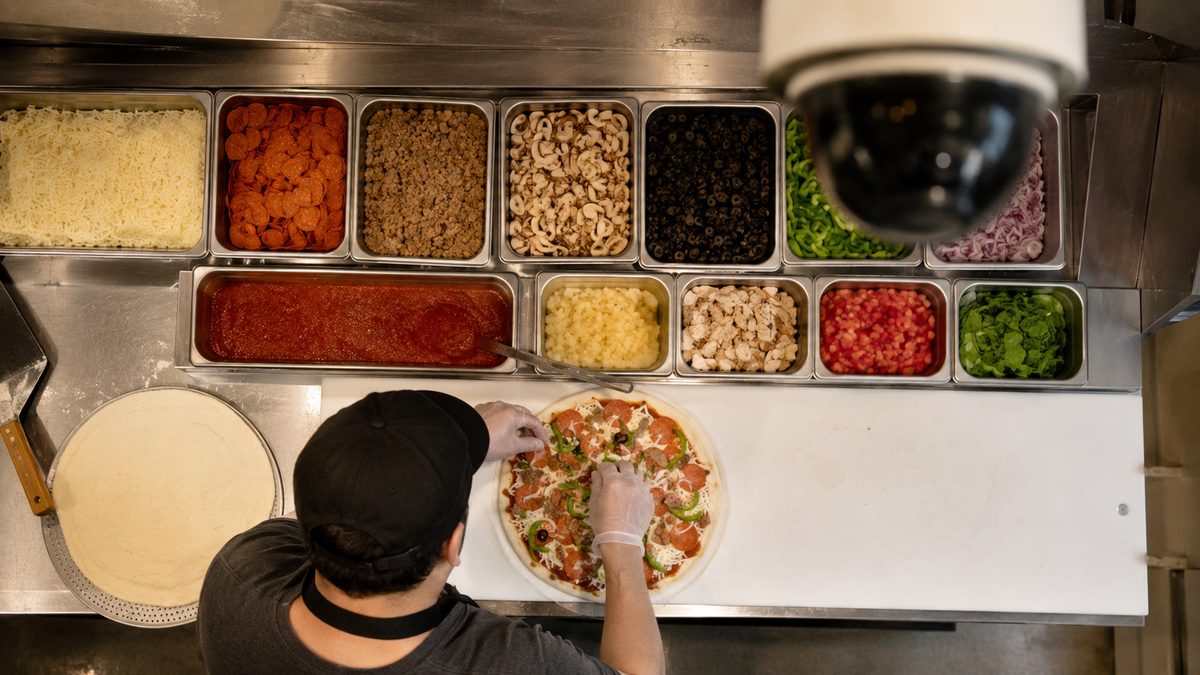
Computer Vision in the Kitchen: How AI Sees What Managers Miss
Your best general manager knows, within seconds of watching a station, whether the work is happening correctly. They can spot a heavy-handed portioner, a skipped prep step, or a build that is out of sequence just by watching. It is the skill that separates great operators from average ones.
The problem is that this skill does not scale. Your best GM cannot watch every station, on every shift, in every location. And the moments when things go wrong are rarely the moments when a manager happens to be standing there.
Computer vision is the technology that gives that "experienced GM eye" to every station simultaneously. This article explains what it is, what it can and cannot do, and why the most effective implementations feel like guidance rather than surveillance.
What Computer Vision Actually Is (In Plain Language)
Strip away the jargon and computer vision is straightforward: it is software that can "watch" a camera feed and understand what it sees. Not just record. Understand.
A security camera records footage. A computer vision system watches that footage in real time and recognizes objects, actions, sequences, and states. It can tell the difference between lettuce and spinach, between a properly wrapped burrito and a loose one, between a worker who just sanitized their hands and one who did not.
This capability has matured dramatically in the last several years, driven by the same AI advances behind autonomous vehicles and medical imaging. What was once a research curiosity is now fast enough, accurate enough, and affordable enough for commercial food service environments. This capability is central to what we call Generation 3 training technology, which we map out in The Complete Guide to AI-Powered Restaurant Training in 2026.
What AI Vision Can Detect in a Kitchen
The specific capabilities that matter for restaurant operations fall into several categories:
Portioning and Quantities
Computer vision can estimate the quantity of ingredients being used. It can detect whether a protein portion is within spec or drifting heavy. Whether a sauce application is consistent or varying significantly between builds. Whether garnish is being applied or skipped.
This matters because portioning drift is one of the largest silent costs in food service. A 15% over-portion on your primary protein, sustained across thousands of servings per week, represents substantial uncontrolled food cost. Managers catch some of it, some of the time. Vision systems can catch it continuously.
Sequence and Steps
Many products require assembly in a specific order. The cheese must go on before the grill, not after. The sauce goes on the bottom bun first. The wrap gets folded in a particular sequence for structural integrity. Computer vision can follow the sequence of actions and detect when steps are skipped or performed out of order.
Timing
How long has that product been in the hold? When did the current batch of fries drop? Is the assembly pace keeping up with order flow? Vision systems can track time-based factors that humans lose track of during rush periods.
Hygiene and Safety Behaviors
Handwashing, glove changes, temperature checks, surface sanitation. These are critical safety behaviors that are almost impossible to audit continuously with human oversight. Vision systems can verify that safety protocols are being followed as part of the normal work flow.
Station Organization
Mise en place matters. A well-organized station produces faster, cleaner work. Vision systems can detect when stations are not set up correctly before service begins, preventing problems before they cascade into the shift.
See How TamTov Works
AI vision that watches every station. Voice coaching that guides in real time. One standard, every location.
Apply for Early AccessWhat Computer Vision Cannot Do (And Should Not Try)
Honesty about limitations is as important as capabilities. Here is what current AI vision systems cannot reliably do in a commercial kitchen:
Taste and Flavor
No vision system can tell you whether a sauce tastes right. It can verify that the correct ingredients were added in the correct quantities, but the subjective quality of flavor remains a human judgment. Temperature and appearance can serve as proxies for doneness, but sensory quality requires sensory assessment.
Internal Temperature (Without Sensors)
A camera cannot see whether a chicken breast has reached 165 degrees internally. Vision systems can verify that a thermometer was used and observe the displayed reading, or they can integrate with temperature probes, but they cannot independently measure internal food temperature.
Perfect Accuracy in All Conditions
Kitchen environments are challenging for vision systems. Steam, splatter, rapid movement, occlusion (one worker blocking another's hands), and lighting variability all affect accuracy. Good systems are designed to handle these conditions robustly, but no system achieves 100% accuracy 100% of the time. The goal is meaningful improvement over no monitoring, not perfection.
Replacing Human Judgment
Vision systems excel at detecting deviations from defined standards. They are less equipped to handle novel situations, ambiguous scenarios, or decisions that require operational context beyond what is visible at the station. A GM's experience and judgment remain essential for the situations that fall outside normal parameters.
The Honest Framing
Computer vision is not a replacement for good management. It is a force multiplier. It handles the continuous, repetitive observation that no human can sustain, freeing managers to focus on the complex, judgment-intensive work that humans do best.
Guidance, Not Surveillance
This is the section that matters most. Because the difference between a computer vision system that workers embrace and one they resist is not technical. It is philosophical.
The Surveillance Approach
Some systems are designed to catch workers doing things wrong. They generate reports for managers. They flag violations. They create records that can be used for disciplinary purposes. Workers experience these systems as being watched, judged, and documented.
The result is predictable: anxiety, resentment, and gaming behavior. Workers learn to perform for the camera rather than performing for the customer. The system creates compliance without competence.
The Guidance Approach
A fundamentally different design philosophy starts with a different question. Not "how do we catch mistakes?" but "how do we help workers succeed?"
Under this model:
- The system coaches the worker directly, in real time, through an earpiece. There is no report sent to a manager about individual errors.
- Corrections are brief, friendly, and constructive. "A bit less on that one" rather than a written violation notice.
- The system confirms correct execution, building confidence. Workers hear when they are doing it right, not just when they are wrong.
- No facial recognition. The system observes the work, not the worker's identity. It does not matter who is at the station. What matters is whether the task is being performed correctly.
- The goal is making the worker better, not documenting their failures.
When positioned and designed this way, the worker experience shifts from "I'm being watched" to "I have help." New hires in particular appreciate having constant, patient guidance available. They do not have to guess whether they are doing it right. The system tells them. This visual, contextual approach is especially effective for multilingual restaurant teams, where the coaching works regardless of what language a worker speaks.
The system exists to make frontline teams better, faster, and more confident. Workers feel the difference from their first shift.
Privacy by Design: What Responsible Implementation Looks Like
For operators evaluating vision-based systems, privacy is not just an ethical consideration. It is a legal and practical one. Workers in many jurisdictions have protections around workplace monitoring. And even where monitoring is permitted, heavy-handed approaches damage culture and accelerate turnover.
Responsible implementation includes:
- No facial recognition or biometric identification. The system should not know or care who is working at the station. It observes actions, not identities.
- Transparent disclosure. Workers should know the system exists, what it observes, and how observations are used. No covert monitoring.
- Data minimization. Process video in real time for coaching; do not store footage indefinitely. The system needs to see the current task, not archive months of recording.
- Positive positioning. Introduce the system as a coaching tool, not a monitoring tool. The language and framing matter enormously for adoption.
- Worker benefit. If the system only benefits management (through compliance reporting) without benefiting workers (through real-time help), the design is wrong.
The Practical Path: From Security Cameras to Smart Stations
Many chains already have cameras in their kitchens for security purposes. The infrastructure gap between a security camera and a vision-enabled coaching system is smaller than most operators assume:
- Camera quality: Most modern security cameras provide sufficient resolution. Purpose-built stations may use specialized cameras for optimal angles and clarity.
- Processing: AI processing can happen on-site (edge computing) or in the cloud, depending on the system's architecture and latency requirements.
- Installation: The most operator-friendly systems retrofit into existing stations without requiring remodeling, equipment replacement, or significant downtime.
- Integration: Vision data becomes most powerful when connected to existing systems (POS, inventory, scheduling), creating a complete operational picture.
Who Is Adopting This Technology
Computer vision in food service is not a future concept. It is in active development and early deployment across several segments:
- QSR chains focused on drive-thru speed, portioning accuracy, and new hire ramp-up
- Fresh-prep operations where complex builds and strict food safety protocols demand consistent execution
- Coffee chains where drink consistency drives customer loyalty and repeat visits
- Franchise systems seeking scalable quality verification across diverse operators -- a challenge we examine in Why Your Franchise Locations Perform Differently
The common thread: multi-location operations where consistency matters, margins are tight, and the cost of variability is measurable. These are the environments where AI execution coaching delivers the most immediate value.
Questions Operators Should Ask
If computer vision for kitchen operations is on your technology roadmap, here are the questions that will separate serious solutions from premature ones:
- What is the latency? If the system detects a portioning error, how quickly does coaching reach the worker? Seconds matter. Minutes are too late.
- How does it handle kitchen conditions? Steam, grease, rapid movement, variable lighting. Ask for performance data in real kitchen environments, not lab conditions.
- What is the worker experience? Ask to see the product from the worker's perspective, not just the management dashboard. How does a new hire experience their first shift with the system?
- How is privacy handled? Get specific answers on facial recognition, data retention, employee notification, and compliance with your jurisdiction's workplace monitoring rules.
- What does installation require? Time, cost, downtime, and impact on existing operations. A system that takes three months to deploy at one location is not viable for a 200-location chain.
- How quickly can it learn your standard? Every chain is different. How does the system adapt to your specific recipes, portions, and procedures?
See AI Vision Coaching in Action
TamTov uses computer vision and real-time voice guidance to coach frontline workers while they work. No facial recognition. No surveillance. Just guidance that makes every shift a learning shift. We are selecting early design partners now.
Apply for Early AccessThe Bigger Picture
Computer vision in the kitchen is not about watching workers more closely. It is about seeing the work clearly enough to help, in the moment, at scale. The best managers have always done this instinctively. The technology simply makes it possible for that quality of attention to be present at every station, every shift, in every location simultaneously.
For operators managing dozens or hundreds of locations, this is the difference between hoping your standards are maintained and knowing they are. Between finding problems after they have compounded and correcting them before they cost a dollar.
The technology is ready. The question is whether your operation is ready to see what has always been there, just out of view.