The Complete Guide to AI-Powered Restaurant Training in 2026
If you operate a multi-location restaurant chain, you already know the math is brutal. The Bureau of Labor Statistics puts QSR turnover above 130% annually. The National Restaurant Association estimates each departure costs $5,864 in recruiting, onboarding, and lost productivity. And 70% of operators report positions that remain stubbornly hard to fill.
Training has always been the lever operators try to pull. Better training, the thinking goes, means faster ramp-up, fewer errors, lower turnover. But the tools available to most chains have barely evolved in a decade. Until now.
This guide breaks down how artificial intelligence is reshaping restaurant training from the ground up. Not in theory. Not in a pilot lab. In the daily operations of multi-location chains that need every new hire performing at standard before the next one walks in the door.
The Three Generations of Restaurant Training Technology
To understand where AI training is headed, it helps to see where it has been. Restaurant training technology has evolved through three distinct generations, each solving a different problem while leaving others untouched.
Generation 1: Digitized Checklists (2010-2018)
The first wave replaced clipboards with tablets. Products like Zenput and Jolt digitized task lists, made completion trackable, and gave area managers visibility into what was supposedly getting done at each location.
The problem: a checked box does not mean correct execution. A worker can mark "station sanitized" without actually sanitizing to standard. The system tracks compliance theater, not real performance.
Generation 2: Mobile Learning and Comms (2018-2024)
The second wave brought short-form video training and internal communication tools to the frontline. Companies like Zipline, Yoobic, eduMe, and Bites made it possible to push bite-sized training content to workers' phones and track completion.
This was a genuine improvement. Training became faster to deploy, easier to update, and possible to deliver in multiple languages. But it still suffered from a fundamental limitation: it happened away from the work. A worker watches a 3-minute video on portioning, then walks to the station and portions from memory. The gap between learning and doing remained wide open.
Generation 3: Real-Time Execution Coaching (2025-Present)
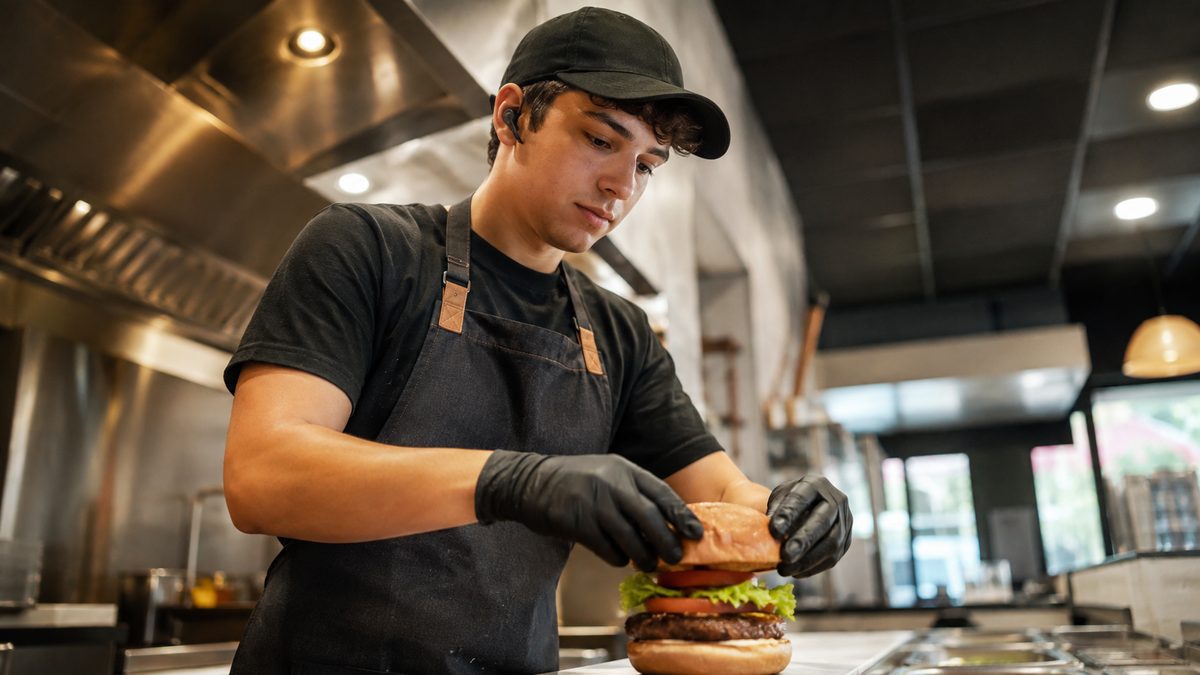
The third generation eliminates that gap entirely. Instead of training workers before or after the work, AI systems now coach them during the work. Using computer vision, smart sensors, and real-time voice guidance, these systems see what a worker is doing, compare it against the chain's standard, and provide immediate, context-aware coaching through an earpiece.
This is not an incremental improvement on video learning. It is a fundamentally different approach. The worker never needs to leave the station, open a tablet, or consult a manual. The system observes, understands, and guides in real time.
How AI Restaurant Training Actually Works
The phrase "AI training" has been stretched to cover everything from chatbots that answer employee questions to systems that auto-generate quiz content. Here is what the most advanced approaches actually do, and why the differences matter.
AI-Generated Content
Some platforms use generative AI to automatically create training materials from menus, recipes, or SOPs. Upload your recipe card, and the system produces a training module, quiz, or video script. This is useful for content creation speed, but it does not change when or how the training is delivered. The worker still learns in one context and performs in another.
AI-Powered Learning Management
More sophisticated LMS platforms use AI to personalize learning paths, recommend content based on role or performance, and adapt difficulty based on quiz results. Think of it as Netflix recommendations applied to training modules. The training is smarter, but it is still separate from the work.
AI Vision and Real-Time Coaching
The most advanced approach uses computer vision to watch the work itself. Cameras or sensors at the station observe what the worker is doing, a processing layer compares each action against the chain's defined standard, and voice guidance is delivered through an earpiece in the moment the gap appears. For a deeper look at how this technology works in kitchen environments, including what it can and cannot detect, see Computer Vision in the Kitchen: How AI Sees What Managers Miss.
When a worker portions too much avocado, the system does not generate a report for a manager to review next week. It says, in that moment, "a little less on the avo." When a new hire skips a step in the build sequence, the system catches it before the product goes out the window.
This approach transforms every shift into a training shift. There is no separation between learning and doing. The correction happens in context, which is how motor skills and habits are actually formed.
See How TamTov Works
AI vision that watches every station. Voice coaching that guides in real time. One standard, every location.
Apply for Early AccessComparing Approaches: What Matters for Multi-Location Chains
| Capability | Gen 2 (LMS/Video) | Gen 3 (AI Execution) |
|---|---|---|
| When training happens | Before or after the shift | During the shift |
| Verification method | Quiz scores, completion rates | Observed execution accuracy |
| Language dependency | Must translate all content | Visual + contextual (language-light) |
| Manager time required | Moderate (assign, review, follow up) | Minimal (system coaches directly) |
| Works for new hires on day 1 | Partially (pre-shift modules) | Fully (guides through every task) |
| Measures actual execution | No | Yes |
| Scales across locations uniformly | Content does; execution does not | Both content and enforcement scale |
The ROI Case for AI Training
Operators do not adopt technology for its novelty. They adopt it because the numbers work. Here is how to think about the return on AI training investment.
The Cost of Slow Ramp-Up
Most QSR operators report that new hires take 10-15 shifts to reach full productivity. During that ramp period, a worker produces roughly half the output of an experienced team member while consuming the same wages. Across a chain hiring hundreds of workers per year, the cumulative cost of that productivity gap can reach six or seven figures annually.
If AI coaching compresses ramp-up from 12 shifts to 2 or 3 shifts, the recovered output per hire is immediate and calculable. We break down the full math behind that compression in From 12 Shifts to 2: The New Math of Restaurant Employee Onboarding. For a chain paying $100 per shift with $900 in shift revenue, saving 10 shifts of ramp time recovers approximately $4,500 per hire in combined wages and output.
Use the TamTov savings calculator to run these numbers with your actual operation's figures.
The Cost of Inconsistency
Harder to quantify but equally real: the cost of inconsistent execution across locations. When portioning varies by 15-20% from location to location, food costs swing proportionally. When build quality is inconsistent, customer satisfaction scores diverge and repeat visits drop at underperforming sites. For a closer look at why locations with identical SOPs still perform differently, see Why Your Franchise Locations Perform Differently.
AI execution coaching does not just train new hires. It continuously verifies that experienced workers maintain standard. That ongoing calibration is something no LMS, no matter how sophisticated, can provide.
The Cost of Turnover
The National Restaurant Association's $5,864 per-departure figure accounts for recruiting, administrative processing, and training investment lost. But it does not capture the full picture: the impact on team morale, the burden on remaining staff who pick up extra responsibilities, and the customer experience degradation during understaffed periods.
Workers who feel supported and competent from their first day are measurably more likely to stay. When the system removes the anxiety of "figuring it out" and replaces it with steady, patient guidance, the emotional experience of the job changes. That matters for retention.
What to Look for in an AI Training Platform
If you are evaluating AI training solutions for a multi-location restaurant operation, here are the criteria that separate genuine capability from marketing language.
1. Does It Verify Execution or Just Deliver Content?
The most important question. Many platforms describe themselves as "AI-powered" but only use AI to generate or recommend content. Ask: can the system tell you whether a specific task was performed correctly at a specific station on a specific shift? If not, it is a smarter LMS, not an execution system.
2. Does It Work in Real Time or After the Fact?
A system that generates reports about yesterday's performance is useful for managers but does nothing for the worker making the mistake right now. Real-time systems intervene before the error becomes a defect, a complaint, or a waste.
3. How Does It Handle Multiple Languages?
Multi-location chains typically employ workers who speak a range of languages. Text-heavy solutions require translating every piece of content. Visual AI systems that coach through demonstration and simple directional voice cues are inherently less language-dependent. Ask how the system handles a worker whose primary language is not English.
4. What Does the Worker Experience?
Technology that feels like surveillance will be resisted by workers and may accelerate turnover rather than reduce it. The best systems feel like guidance, not monitoring. Ask: does the worker experience this as help or as a watching eye? Is it designed to make them better, or to catch them failing?
5. How Quickly Can It Be Deployed?
Solutions that require extensive hardware installation, months of configuration, or significant changes to existing workflows will stall at the pilot phase. Ask about installation time, integration requirements, and what changes (if any) are needed to existing stations or equipment.
6. Does It Scale Uniformly?
A solution that works beautifully at one pilot location but cannot be rolled across 100+ sites is a science project, not a business tool. Ask about multi-location deployment, centralized management, and how the system maintains consistency at scale.
The Privacy Question
Any system that uses cameras or sensors in a workplace raises legitimate privacy questions. Operators evaluating AI training should ask:
- Does the system use facial recognition? The best systems do not need to identify who a worker is. They observe what is being done at a station, not who is doing it.
- What data is stored, and for how long? Processing video in real time for coaching does not require permanent storage of footage.
- How is the system positioned to workers? When workers experience the system as a coach that helps them succeed, adoption is fundamentally different than when they experience it as surveillance.
- What are the compliance implications? Different jurisdictions have different rules around workplace monitoring. Your vendor should have clear guidance for your specific market.
The distinction between "guidance" and "surveillance" is not just ethical. It is practical. Workers who feel watched perform anxiously. Workers who feel coached perform confidently.
The Shift from Training to Execution
Perhaps the most important conceptual shift in AI restaurant training is this: the goal is not training. The goal is execution.
Training is a means to an end. The end is consistent, high-quality execution at every station, on every shift, in every location. When you reframe the objective this way, the limitations of content-delivery approaches become clear. Delivering better content is useful but insufficient. What matters is whether the work gets done correctly.
This is why forward-thinking operators are moving from "training platforms" to what might be called an Execution OS: a system that does not just teach workers what to do, but verifies that it gets done and intervenes when it does not. The difference is the same as the difference between giving someone a recipe and having a chef stand beside them while they cook.
Where the Industry Is Headed
Based on current adoption patterns and the PAR QSR Operational Index showing 40% of operators prioritizing AI for training and labor efficiency, the trajectory is clear:
- 2026-2027: Early adopters deploy AI execution systems across pilot locations. Category definitions solidify. First published ROI data emerges.
- 2027-2028: Mid-market chains begin evaluation cycles. AI coaching becomes a standard line item in technology roadmaps alongside POS and inventory.
- 2028-2030: Execution measurement becomes a baseline expectation. Chains without real-time quality verification are at a competitive disadvantage in franchisee recruitment and consumer trust.
The chains that move now are not just buying technology. They are positioning themselves as partners in defining how the category works, what the standards should be, and how the systems adapt to the realities of their specific operations.
Getting Started: Questions for Your Team
Before evaluating any platform, align your leadership team on these questions:
- How many shifts does it currently take a new hire to reach full productivity at our chain?
- What does that ramp-up period actually cost us, multiplied across all locations?
- How do we currently verify that SOPs are being followed? How confident are we in that verification?
- If we could measure execution accuracy at every station, what would we do differently?
- Are we open to being a design partner with an emerging platform if it means shaping the system to our specific needs?
That last question matters. The AI execution category is still being defined. The operators who engage earliest do not just adopt a tool. They influence what the tool becomes.
Shape the Future of Restaurant Execution
TamTov is building the AI Execution OS for multi-location QSR chains. We are selecting a limited number of design partners to work with directly during our early access program. Your operations, your standards, your input.
Apply for Early AccessKey Takeaways
- AI restaurant training has evolved through three generations: digitized checklists, mobile learning, and real-time execution coaching.
- The critical difference is when and where training happens. Real-time systems coach during the work, eliminating the gap between learning and doing.
- ROI comes from three sources: faster ramp-up, continuous consistency, and reduced turnover.
- Privacy design matters. The best systems feel like guidance, not surveillance.
- The category is shifting from "training" to "execution." The goal is verified performance, not content delivery.
- Early movers have the opportunity to shape the category as design partners, not just buyers.