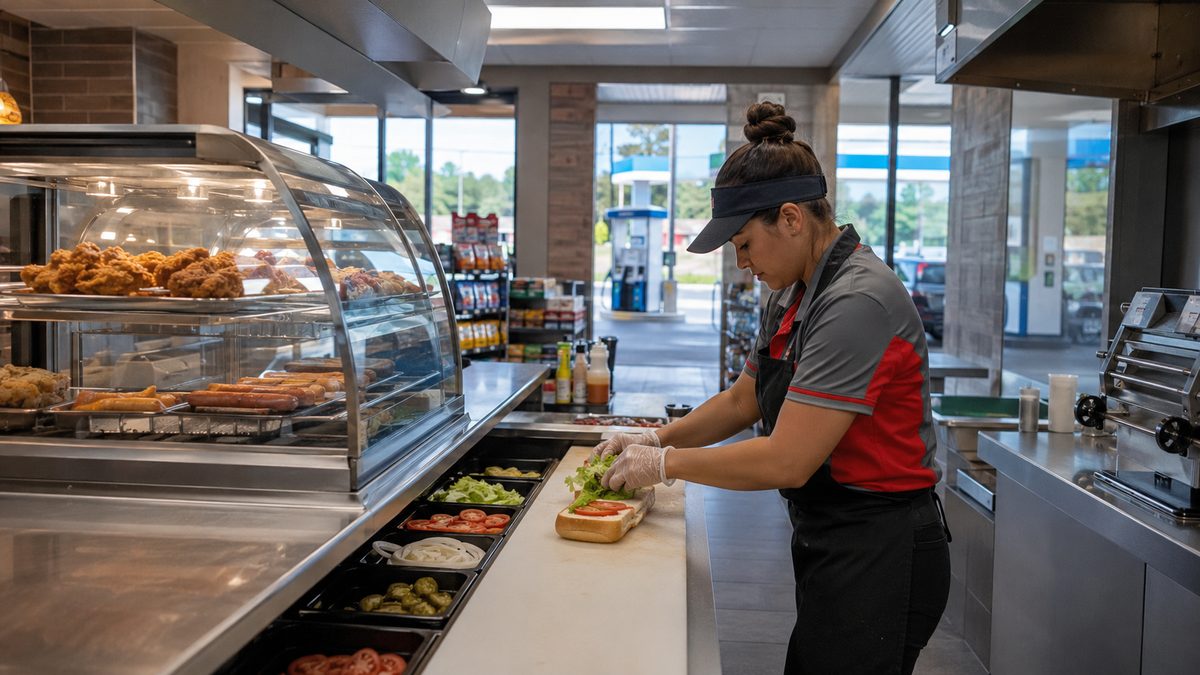
The Fastest-Growing Kitchen in America Is Inside a Gas Station
One of the largest pizza chains in the United States has no dining rooms, no delivery drivers and no pizzerias. It sells fuel.
Casey's General Stores, roughly three thousand locations across the Midwest, is by its own account the fifth-largest pizza chain in America. In June 2026 it announced four hundred more stores over three years, with the CEO describing the strategy as expanding the food business and leveraging technology to improve efficiency and execution.
That is not a convenience store talking. That is a restaurant company that happens to own gas pumps.
Foodservice is no longer the side business
The numbers behind this shift are not subtle, and they have moved fast.
Meanwhile fuel, the historic reason the business existed, fell 5.4% to $476.3 billion in 2025. The profit engine has moved inside the building, and inside the building it has moved to the hot case, the pizza oven and the sandwich station.
This is not a US-only story. McKinsey's 2026 European grocery work puts foodservice growth in the channel at 6.8% a year against 4.8% for grocery, with 47% of Gen Z buying food-to-go weekly. In Poland, Żabka passed 12,900 stores by mid-2026 and has been putting professional pizza ovens into new locations. Across two continents, the same thing is happening: retail formats built for packaged goods are installing kitchens.
And the intent is committed, not exploratory. In a NACS survey, 87% of respondents said at least 10% of their total new-store investment goes to foodservice.
The kitchen arrived. The kitchen workforce did not.
Here is where the transformation gets operationally uncomfortable. A restaurant that produces this much fresh food has a structure built for it: dedicated stations, a shift-long station assignment, a kitchen hierarchy, someone whose entire job is quality at the pass.
A convenience store has roughly 20 employees, averaging around $15 an hour, running a business that also sells fuel, cigarettes, lottery, coffee and car washes -- at QSR-level turnover and its associated labor costs.
There is no station
The person assembling a breakfast sandwich is the same person who was at the register ninety seconds ago and will be back there in two minutes. Every task is interrupted by design. In a restaurant, interruption is an exception; in a c-store it is the operating model. The cost lands exactly where you would expect: the moment of re-entry, when a worker returns to a half-finished task and has to reconstruct where they were.
There is no kitchen hierarchy
No sous chef, no expo, no line cook who has done this for six years and corrects you without being asked. The quality control layer that restaurants take for granted simply does not exist in the format. Whoever is on shift is the entire quality function.
The standard being compared against moved
Customers no longer grade c-store food against other c-store food. They grade it against the quick-service restaurant across the street. The industry knows this: only 18% of consumers believe convenience stores are as capable as QSRs of offering fresh, quality prepared food. That gap is not a marketing problem. You cannot advertise your way past a sandwich that was assembled differently at each of your stores.
Convenience stores became restaurants faster than their workforce did.
See How TamTov Coaches at the Station
AI vision and smart sensors follow the work. Short voice guidance reaches the worker while the task is happening, with nothing extra to log or tap.
Apply for Early AccessWhy the existing technology does not close this
Food-forward chains are not under-invested in software. Most already run digital checklists, temperature logging and task compliance systems, and those tools do real work — they create an audit trail, they catch a cooler drifting overnight, they satisfy a health inspector.
But look closely at what they measure. They measure whether a record was created. A temperature log confirms someone entered a number. A digital checklist confirms someone tapped a box. Neither one knows whether the sandwich currently being assembled matches the build, whether the portion is right, or whether the worker just skipped a step because a customer walked in mid-task.
That is the difference between compliance and execution. Compliance systems document the past. The work happens in the present, and at the moment it happens, nobody is watching except the worker — who is also, right now, being asked about the pump on lane four.
What a c-store kitchen actually needs
The requirements here are not the same as a restaurant's, and a solution designed for a restaurant line will not survive the format.
Four format-specific requirements
- Survives interruption. Guidance has to help a worker resume a task, not just start one. Re-entry is where c-store execution actually breaks.
- Adds zero steps. Anyone who is covering register, fuel desk and food at once will not open an app, log a number or fill in a screen. If the system requires the worker to do anything extra, it will not be used at peak, which is the only time it matters.
- Measures what sight cannot reach. Weight, temperature and time are where food safety and portion cost live. A camera can see that a hand moved; it cannot see that the hot case has drifted below hold temperature or that the portion is fifteen grams light.
- Assumes no expert on shift. The design cannot depend on an experienced worker being nearby to correct anyone, because frequently there is no such person in the building.
Put together, that points at guidance during the task rather than reporting after it: the standard delivered to the person doing the work, in the moment they are doing it, without asking them to stop and interact with anything. We have written about how the sensing side of that works. Read: Computer Vision in the Kitchen
What operators ask
"Our stores are not kitchens."
By revenue mix, many of them now are. If prepared food is generating close to two-fifths of your in-store gross profit, the food operation is no longer a category — it is the margin. The question is whether it is being managed with restaurant-grade discipline or with the attention level a category that used to be 12% of sales received.
"We already have temperature monitoring."
Then you already own the hardest part of the sale internally: the budget line and the operational habit. Sensor-based food safety proved the concept that stores will accept instrumentation. The open question is what else that instrumentation could be doing during the four hundred assemblies that happen between two temperature readings.
"Our people already do three jobs. This is a fourth."
It is a fourth job only if it demands attention. The design constraint that matters most in this format is that the worker's hands and screen time stay free. Guidance arrives in an earpiece, a few words at a time, and the worker keeps working. If a system in a convenience store requires the employee to look at anything, it has already failed the format.
"We are franchised. I cannot mandate this."
Correct, and that is exactly why execution consistency is harder here than in corporate QSR. It is also why the argument has to be a franchisee-level margin argument rather than a brand-standard argument. The same dynamic plays out in franchised restaurant chains. Read: Why Your Franchise Locations Perform Differently
Your next step
Three questions that will tell you where your food operation actually stands. All three are answerable from data you already have.
- What percentage of your in-store gross profit now comes from prepared food, and what percentage of your operational attention goes to it? The gap between those two numbers is the exposure.
- How much does the same item vary between your highest and lowest performing stores? Not average cost. Spread. The spread is what customers experience.
- How many of your food-prep tasks are completed without interruption? Ask a store manager to observe one lunch period and count. Most operators have never measured it, and the number is usually sobering.
Then run the ramp-up numbers. With roughly 20 employees per store and restaurant-level turnover, the cost of getting a new hire to standard is a chain-level number even in a format nobody thinks of as a kitchen. Try the savings calculator
Key takeaways
- Foodservice now generates 38.9% of in-store gross profit at US convenience stores and 28.5% of in-store sales, up from 11.9% two decades ago, while fuel sales fell 5.4% in 2025.
- The same shift is underway in Europe, where channel foodservice is growing faster than grocery and large operators are installing kitchens at scale.
- The format has restaurant-level production complexity with roughly 20 employees per store, no dedicated stations, no kitchen hierarchy and QSR-level turnover.
- Interruption is the operating model, not the exception, and re-entry into a half-finished task is where execution breaks.
- Checklists and temperature logs document compliance after the fact. They do not change what happens during the task.
- Only 18% of consumers believe c-stores match QSR quality on fresh prepared food — a gap that closes through execution, not marketing.
Your Store Has a Kitchen Now. Coach It Like One.
TamTov brings restaurant-grade execution coaching to convenience retail — AI vision, real-time voice guidance, nothing extra to tap or log.
Apply for Early Access